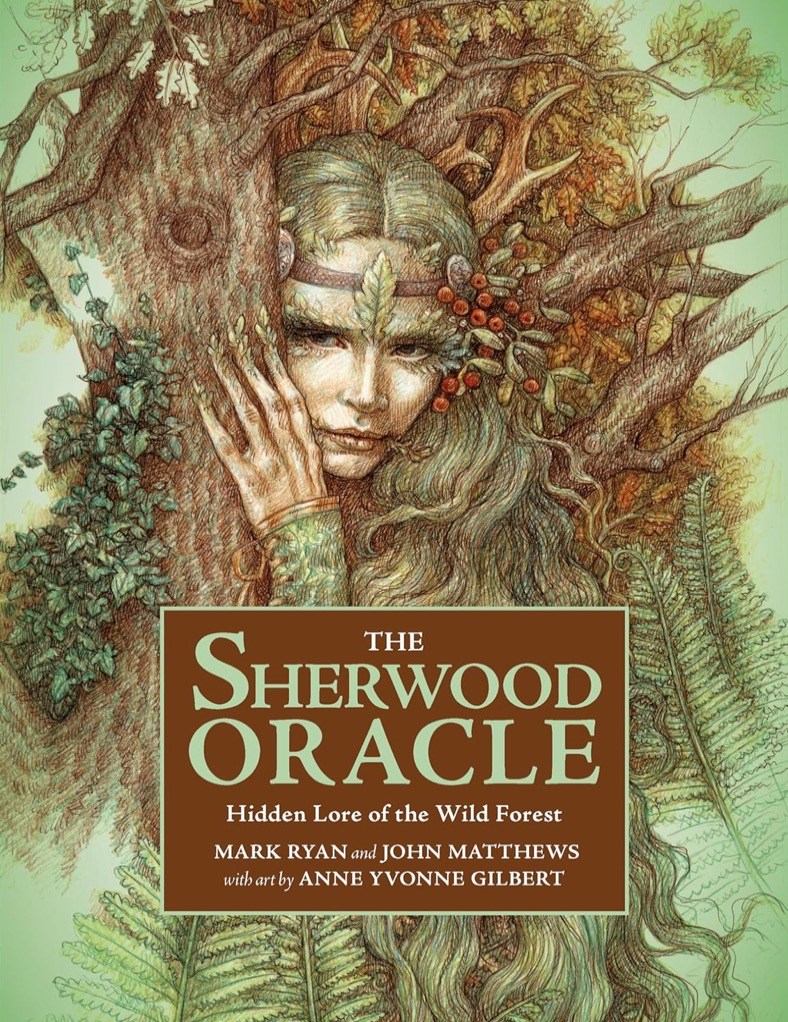
I have been eagerly awaiting the publication of the newest branch of the Wildwood Tarot tree, the Sherwood Oracle. Created by Wildwood authors Mark Ryan and John Matthews, this oracle has a different artist – Anne Yvonne Gilbert.
The deck is published by Sterling Ethos and the US publication date is before that of the UK (UK is end of May 2024).
I was absolutely delighted when a review copy of the deck arrived for me to take a look at – this means I can share my review about the deck before the deck sales are live, allowing you to pre-order it (at all good bookshops!). An order link for Amazon (affiliate link) will be at the end, should you need it.
Let’s get started!
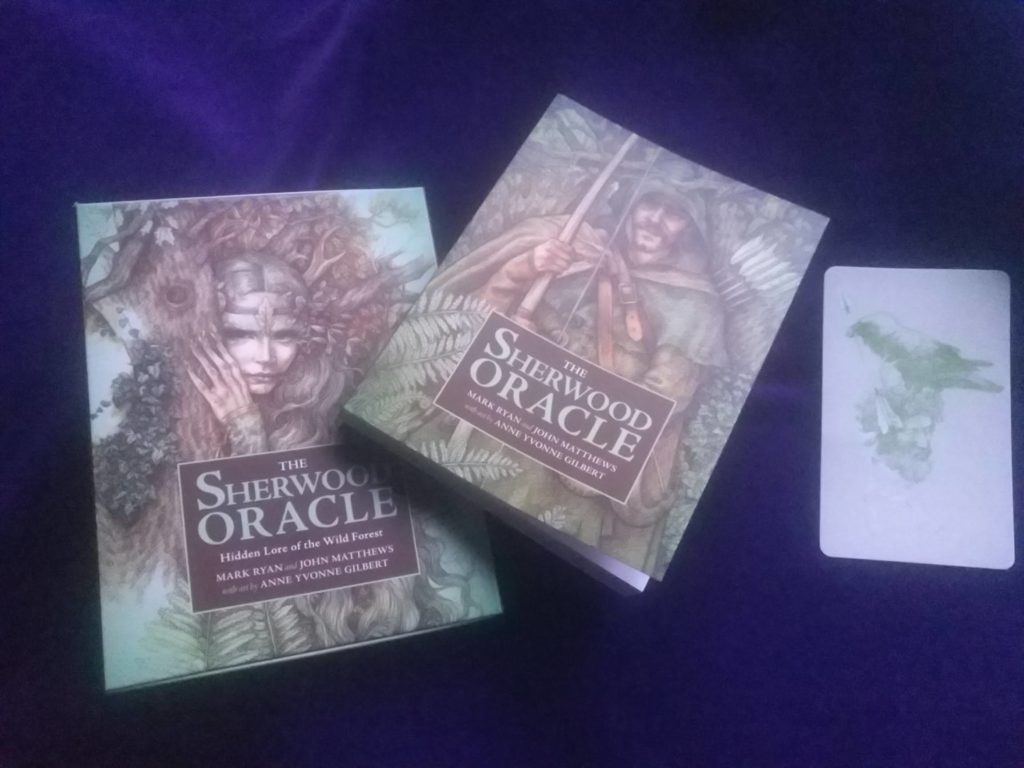
First of all let’s take a look at the box – not because I think you’ll be keeping the cards in the box, but because I want to make it crystal clear what the legitimate deck box looks like, rather than any counterfeited item. Plus, it’s a gorgeous box! With an image of the Green Woman on the front, the flip top is held in place by a magnet – this makes it feel nice and sturdy.
Inside, you have a box-sized companion book, a folded map of Sherwood Forest and nestled in the heart of the box, the cards of the Sherwood Oracle.
I have no patience, so I dived straight into the cards and raced through them, drinking in the imagery. Gilbert uses pencils in predominantly earthy tones which gives the artwork a soft and dreamlike appearance. The cards are borderless (which will make my border-removing friends very happy!). This lack of frame makes the images feel immediate and when placed side by side, the cards flow together. The card stock is standard, I think, with a satin-like finish. I did notice that the Sherwood Oracle cards are not the same dimensions as The Wildwood Tarot – the Wildwood is a couple of mm thinner and the Sherwood about 5 or 6mm longer. This isn’t a problem in itself, of course, but if you had thoughts of combining the Wildwood and the Sherwood into a massive meta-deck, you won’t be able to do so.
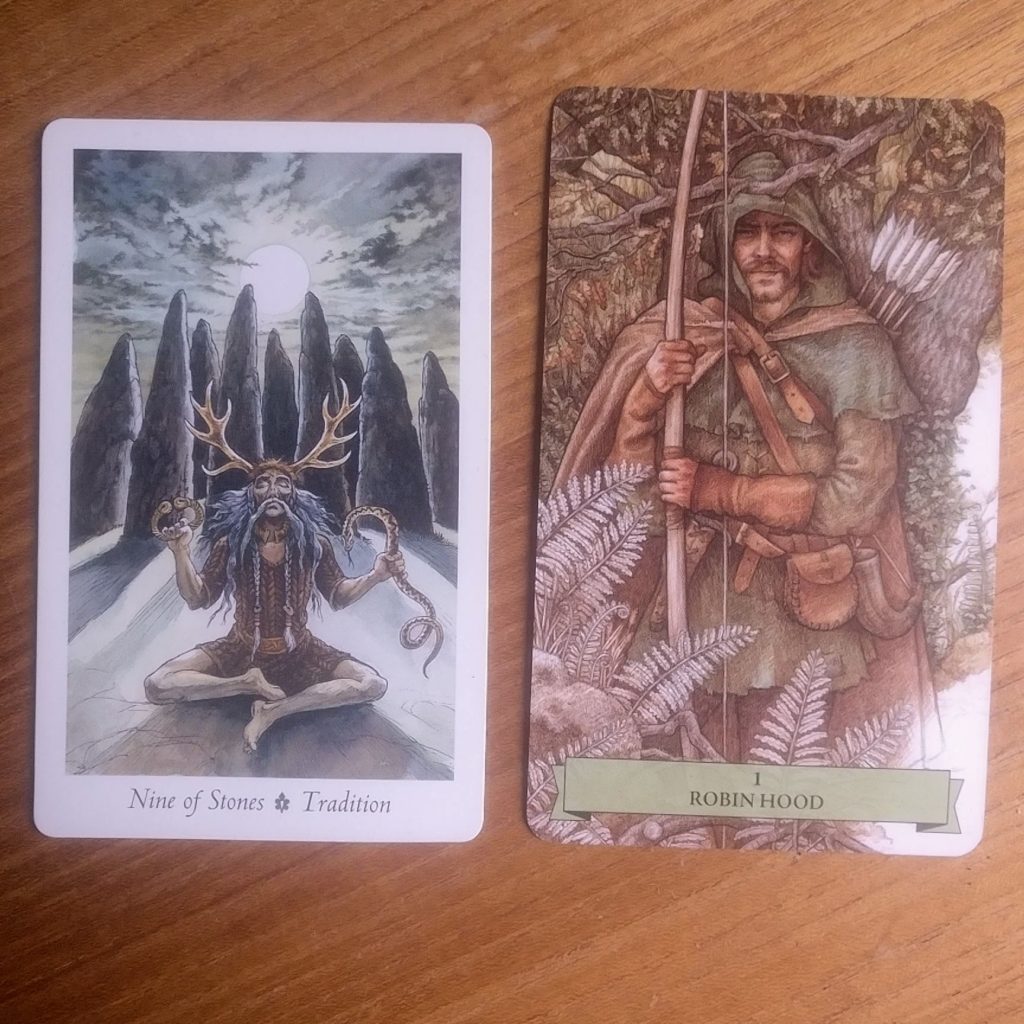
It’s a 35 card deck and features all the characters that you know and love from all things Robin Hood – alongside folkloric names such as Little John, Herne the Hunter and The Green Man there are places from the tales – The Major Oak, Kirklees Priory and Nottingham Castle.
As you might expect, the characters lean heavily on the male side with only three cards having overtly feminine energy – Maid Marion, The Prioress and The Green Woman. I would say that these three cards encapsulate the energies of the tarot’s High Priestess and Empress cards.
The deck is divided into sections:
The Outlaws (Robin and his cohorts) has 14 cards.
The Adversaries (Sheriff of Nottingham etc) has 4 cards
The Wild Ones (Herne the Hunter, Wayland the Smith etc) has 6 cards
The Dancers – The Hoodeners – is only one card (and represents YOUR little gang)
Places in Sherwood – The Major Oak, John Barleycorn’s Field has 10 cards
but one of them, The Way Through The Woods, represents the Seeker
All the cards are named and numbered, with Robin Hood first and The Way Through The Woods numbered 35, last.
It’s vital to have the guide book for working with this deck, otherwise you won’t have a clue what each card means!
Each card has four or five pages devoted to it in the companion book. Each card entry begins with a large monochrome image of the card and is then followed by pointers on how the card works as a companion and a challenger. There is also a blessing, plus lore on an associated tree and concludes with questions that the character might ask, depending on where you find him/her on the Sherwood Forest map sheet. I would have loved to see every tree associated with each character on their card – and this IS the case with many of them, but not all.
The map sheet shows each of the Sherwood places as ‘houses’ for various of the cards. For example, Kirklees Priory is home to the Prioress, Nottingham Castle to the Sheriff of Nottingham.
When using this map as a divining sheet, where you would deal cards randomly onto each house, you will reference this end section for each card to find the appropriate question.
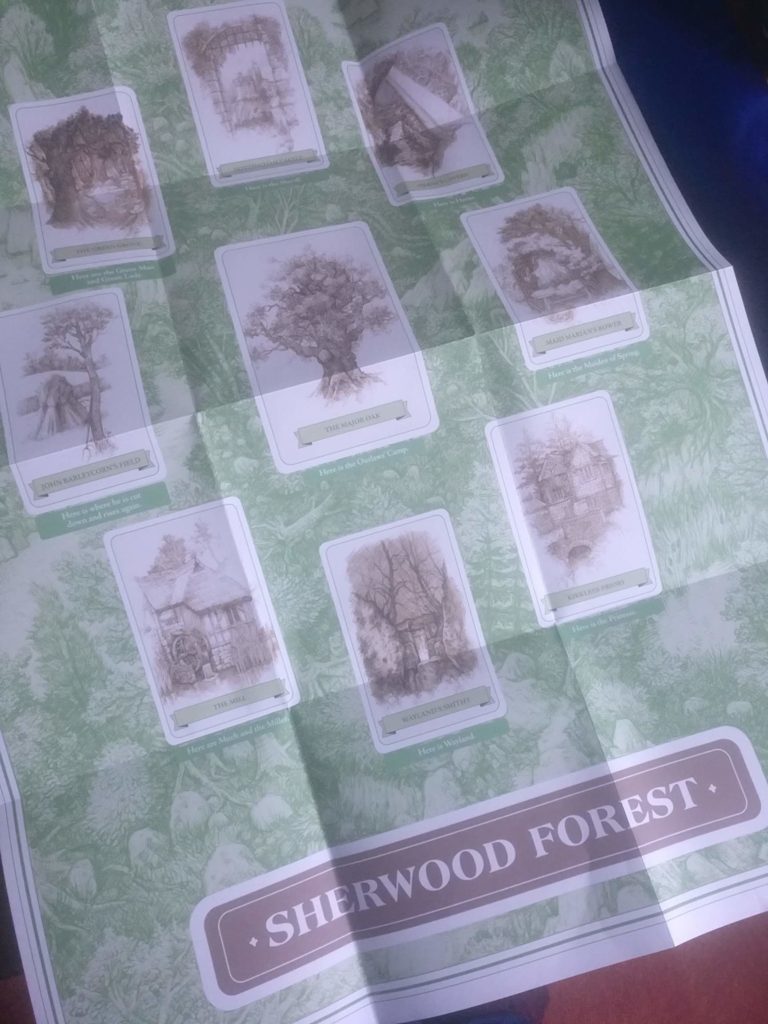
For example, if I drew The Saracen on The Priory, a check at the Saracen’s section in the guide book gives me the question for The Priory: How do you perceive yourself?
The companion book is, at over 250 pages, so much more than just a LWB with definitions of each card. The opening section paints a picture of Robin Hood’s world and invites you in to the Forest. The second section defines the cards and how to use the Place cards with the map, The third section explores how to use the cards – including meditations with the cards called The Wild Ones. The book concludes with extensive lists of excellent resources and further reading.
The $64k question is: How does it read?!
I’m still very much in the ‘getting to grips with it’ stage, but have used it as an amplifier for a Wildwood Tarot reading, the results of which really took me by surprise (and I’ll cover in a separate blog post as this one is ‘normous as it is). I would confirm that it was bang on the money with those Sherwood Oracle cards dove-tailing beautifully into the reading.
At the moment, I am drawing one card in the morning and reading that character’s ‘blessing’ which is proving a lovely thing to do – having a character from the Sherwood tales as a daily guardian is so nice. Yeah, even Guy of Guisborne!
Do I recommend it to Wildwood Tarot fans? Yes I do! It might be a slightly different size and have a different artist, but these cards are most definitely from the same folkloric realm and extend the Wildwood (and Greenwood!) Universe by one more set of cards.
I’m looking forward to seeing the Sherwood Oracle out in the wild and hearing your own thoughts about it too.